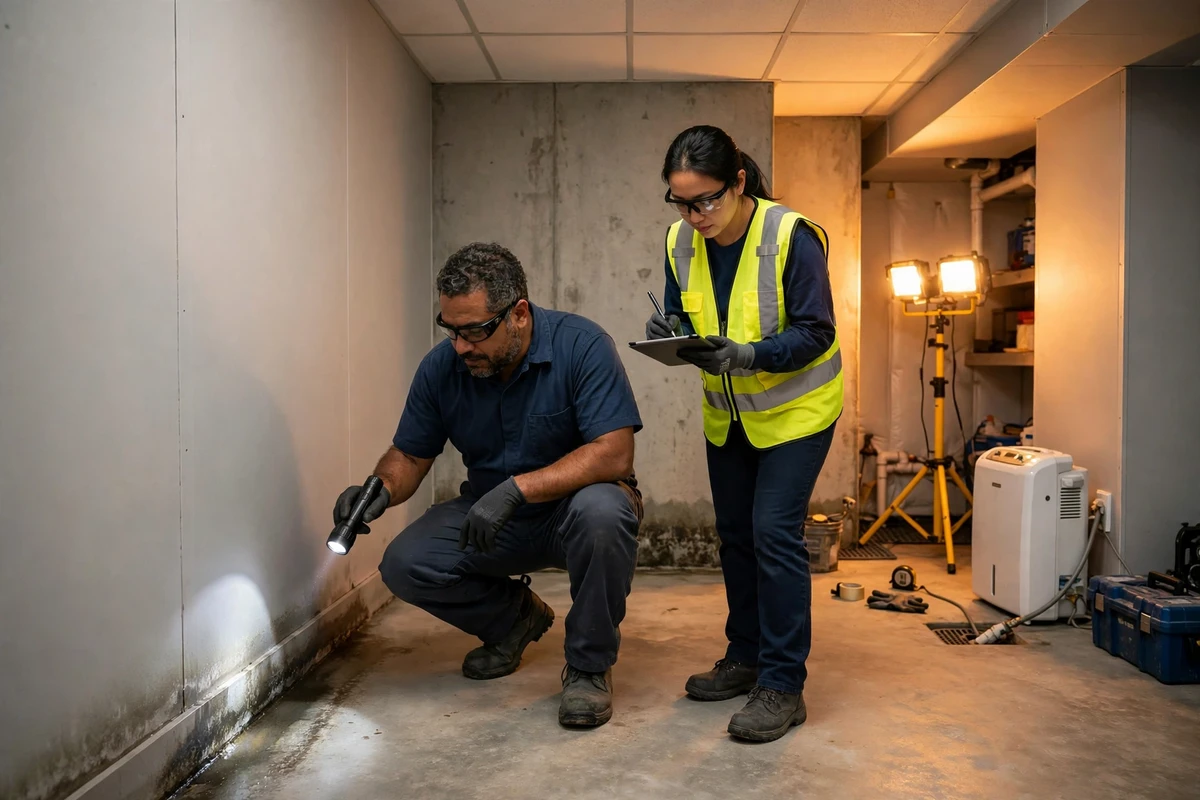
Waterproofing services work best when they start with the source of the water. Rain that overflows gutters, groundwater pressing against the wall, a high water table rising under the slab and summer condensation all look similar on a basement floor, but each calls for a different fix. A pro should be able to explain which one you're dealing with before recommending a system.
Costs vary widely: extending a downspout costs very little, while excavating and membrane-coating a foundation is a major project. Knowing the options helps you compare quotes and avoid paying for more than you need.
Types of Waterproofing Services
Interior Basement Waterproofing
Interior waterproofing manages water that has already reached the foundation instead of trying to stop it at the outside face of the wall. The usual system is a perforated drain laid in a channel cut along the inside perimeter of the floor, a dimpled membrane or wall panel that guides seepage down into that drain, and a sump that pumps the water out. Because nothing outside the house is dug up, it's the approach most often used where yards are small, driveways and patios abut the house, or neighboring buildings are close.
- Water along the floor-wall joint after rain or snowmelt
- Efflorescence (white, chalky deposits) on block or concrete walls
- A musty smell that comes back after cleaning
- Damp carpet or warped flooring in a finished basement
Exterior Foundation Waterproofing
Exterior waterproofing stops water at the outside face of the foundation. The soil is excavated down to the footing, the wall is cleaned and repaired, a waterproof membrane is applied, a drainage board goes over it, and a footing drain carries collected water to a sump or a daylight outlet before the trench is backfilled. It is the most thorough fix for a leaking wall, but also the most disruptive and usually the most expensive, because it means digging up plantings, walkways and sometimes part of a driveway.
- Leaks through the middle of the wall, not just at the floor joint
- Wet wall cavities behind finished drywall
- A failed tar or damp-proof coating seen during a previous dig
- Water entering at window wells or foundation penetrations
Sump Pump Installation
A sump pump sits in a sealed pit at the lowest point of the basement and pumps out water collected by interior or footing drains. The parts that matter most are a pump sized for how much water actually comes in, a check valve so pumped water doesn't fall back into the pit, a discharge line that carries the water well away from the foundation, and a backup. Battery-backup pumps keep running when storms knock out power, which is often exactly when the pump is needed.
- The pump runs constantly or cycles on and off rapidly
- The pump is more than seven to ten years old
- Water in the pit but the pump doesn't start
- Loud grinding, rattling or humming
French Drain and Yard Drainage
A French drain is a gravel-filled trench with a perforated pipe that collects groundwater and surface water and carries it away from the house. Outside, it can intercept water on a slope before it reaches the foundation (often called a curtain drain), or it can run along the footing as a foundation drain. Inside, the same idea is used in an interior perimeter drain. Fabric wrapped around the pipe keeps soil from clogging it.
- Puddles that stay near the foundation for a day or more after rain
- Soggy lawn or erosion on the uphill side of the house
- Water running down a driveway toward the garage
- Mulch or soil washing away from beds along the foundation
Leaking Foundation Crack Repair
Most poured concrete walls develop thin vertical shrinkage cracks as the concrete cures, and a crack that lets water in can usually be sealed from inside by injecting it under low pressure. Polyurethane foam expands to fill the crack and stays flexible, which suits leaks; epoxy bonds the two sides together and is used when structural strength matters. Either way, the crack should be injected through its full depth, not just covered on the surface.
- Water trickling from a vertical crack after rain
- Damp streaks or efflorescence along a crack
- A crack that has been patched and leaks again
- Rust stains coming from a crack (a sign of corroding rebar or wall ties)
Crawl Space Encapsulation
Crawl space encapsulation seals the space under the house so ground moisture and humid outdoor air can't keep the framing damp. A heavy vapor barrier covers the soil and runs up the foundation walls, seams are taped, vents are sealed, and the space is dehumidified or conditioned. Where water actually pools in the crawl space, a drain and sump go in first. The result is drier framing, fewer musty odors upstairs and less risk of mold and wood rot.
- Musty smell on the first floor
- Cupping or buckling hardwood floors
- Insulation falling down between floor joists
- Mold or white fuzzy growth on joists
Gutters, Downspouts and Grading
A large share of basement leaks start at the roof. Every inch of rain on 1,000 square feet of roof produces roughly 600 gallons of water, and gutters that overflow or downspouts that empty at the foundation put that water right where it does the most harm. Downspout extensions that carry water 4 to 6 feet or more away, or buried lines to a dry well or the street where local rules allow, are often the simplest fix.
- Gutters that overflow in heavy rain
- Downspouts that end within a few feet of the foundation
- Soil, mulch or patios that slope toward the house
- Basement leaks on the same side as a downspout
Basement Humidity Control
Not every damp basement leaks. In summer, warm humid air meets cool foundation walls and floors and condenses, leaving them damp even when no water is coming in. A simple test is to tape a square of plastic to the wall for a few days: moisture under the plastic means it's coming through the wall; moisture on top means it's condensation. Keeping relative humidity below about 50 to 60 percent with a properly sized dehumidifier limits mold and musty odors.
- Musty or earthy smell in the basement
- Condensation on cold water pipes or walls
- Mildew on stored boxes, clothing or furniture
- Relative humidity above 60 percent on a hygrometer
Backwater Valves and Sewer Backup Protection
A backwater valve is a one-way valve on the main sewer line that lets wastewater leave the house but closes when the sewer surcharges, so sewer water can't come back up through basement drains. It's especially relevant in areas served by combined sewers, where heavy rain can fill the public lines. The valve needs to be sized and installed by a licensed plumber, usually with a permit, and it needs periodic cleaning and testing to work when it's needed.
- Water coming up through the basement floor drain during storms
- Sewage odor after heavy rain
- Gurgling drains when it rains hard
- Neighbors on the same block with similar backups
How to Compare Waterproofing Services
- Ask the contractor to explain where the water is coming from and why.
- Get a written scope that names the system, its length, the sump and the discharge location.
- Ask how the system will be maintained and what any warranty covers and excludes.
- Check licensing and insurance requirements for your town or county.
- Get more than one opinion for large projects.
Where Waterproofing Help Is Available
Coverage includes 118 New York communities, each with its own page. Choose a state to see local conditions and communities.
- Alabama
- Georgia
- Illinois
- Indiana
- Maryland
- Minnesota
- New Jersey
- New York
- North Carolina
- Ohio
- Oregon
- Pennsylvania
- Tennessee
- Virginia
- Washington
- Wisconsin
Guides and Articles
- Why Long Island Basements Take on Water
- Grading, Gutters and Downspouts: The First Fix for a Wet Basement
Dawn Waterproofing connects homeowners with independent local service providers and does not perform the work.