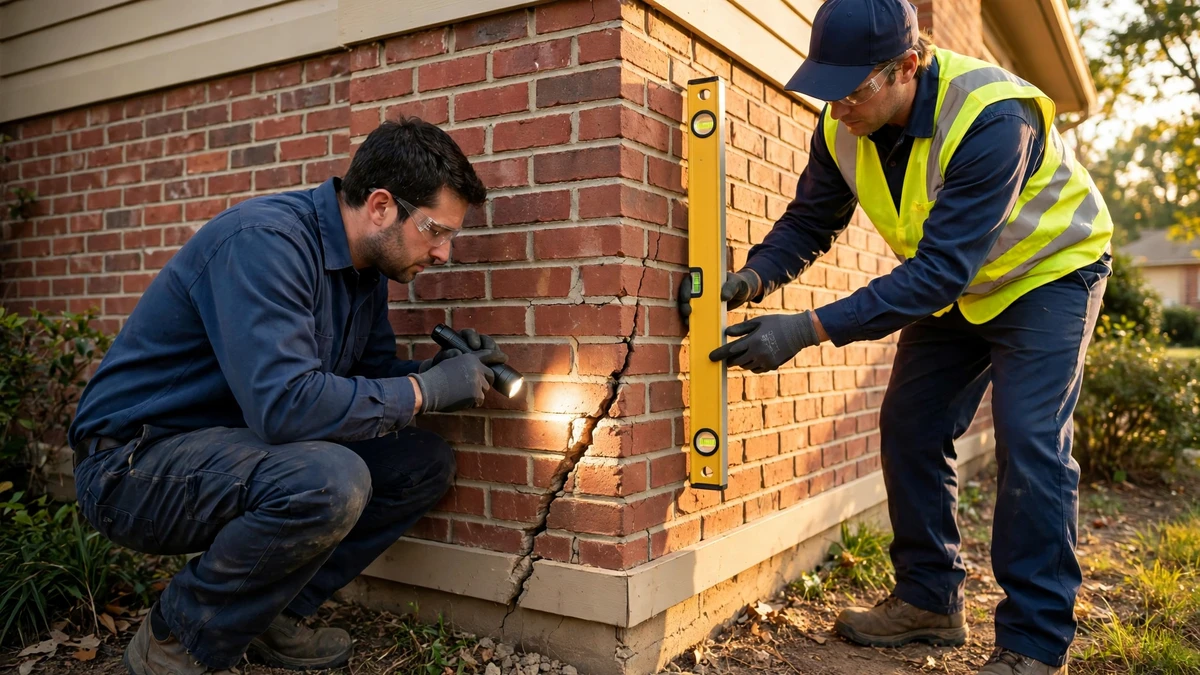
Foundation repair services range from sealing a single crack to underpinning an entire wall. The right repair depends on what's moving, why it's moving and whether it's still moving. A good contractor or structural engineer will measure the house, map the cracks and explain the cause before proposing a fix.
Most foundation problems are linked to water: soil that softens when saturated, clay that swells and shrinks, frost that heaves shallow footings. Fixing drainage is often part of a lasting repair.
Types of Foundation Repair Services
Foundation Inspection and Assessment
A foundation evaluation starts with how the house is moving, not just where it's cracked. Inspectors measure floor elevations with a digital level or manometer, check walls for plumb, map cracks by width, direction and offset, and look at drainage and soil around the house. The pattern tells the story: cracks wider at the top than the bottom, doors that stick on one side of the house and floors that slope toward one corner usually point to settlement in that area.
- Doors and windows that stick or won't latch
- Cracks in drywall above doors and windows
- Sloping or bouncy floors
- Gaps between walls and the ceiling or floor
Foundation Crack Repair
Not all foundation cracks are equal. Thin vertical cracks in poured concrete are usually shrinkage and are mainly a leak risk. Stair-step cracks in block or brick, horizontal cracks, cracks that are wider at one end, and cracks where one side has moved relative to the other indicate movement and need an evaluation. Epoxy injection bonds a structural crack back together; polyurethane injection seals a crack against water while allowing slight movement.
- Horizontal cracks in a basement wall
- Stair-step cracks in block or brick
- Cracks wider than about 1/4 inch
- One side of a crack offset from the other
Bowing and Leaning Wall Repair
When saturated or frozen soil pushes on a basement wall, block walls can crack horizontally and bow inward, and poured walls can tilt. Wall anchors run steel rods through the wall to plates buried in stable soil in the yard and can be tightened over time; steel I-beam braces run from the floor to the floor joists; carbon fiber straps bonded to the wall add tensile strength for walls with limited movement. The right choice depends on how far the wall has moved and how much room there is outside.
- Horizontal crack along the middle of a block wall
- Wall bowing inward or leaning at the top
- Stair-step cracks at the corners
- Gaps between the wall and the floor joists
Settling Foundation Repair
Settlement happens when the soil under part of a footing compresses, washes out or shrinks, and that section of the house drops. Common causes include fill that was never properly compacted, soil softened by poor drainage or a leaking pipe, tree roots drawing moisture from clay, and additions built on shallower footings than the original house. The repair usually involves stabilizing the footing on firmer soil or bedrock with piers.
- Cracks wider at the top than at the bottom
- Floors that slope toward one corner
- Doors that rub at the top on one side
- A gap where an addition meets the house
Push Piers and Helical Piers
Piering transfers the weight of a settling footing down to load-bearing soil or bedrock. Push piers are steel tubes driven hydraulically under the footing, using the weight of the house as resistance. Helical piers have steel plates shaped like screw threads and are turned into the ground with a torque motor, so they can support lighter structures and new loads such as additions and porches. Once the piers are installed, brackets connect them to the footing, and the house can sometimes be lifted back toward its original position.
- Ongoing settlement that crack repair hasn't stopped
- A corner of the house measurably lower than the rest
- An engineer's report recommending underpinning
- A new addition or heavy load planned on an old footing
Slab and Concrete Leveling
Sunken driveways, walks, patios, garage floors and basement slabs can often be lifted instead of replaced. Polyurethane foam injection pumps expanding foam through small holes drilled in the slab; it's light, cures quickly and adds little weight to soft soil. Mudjacking uses a cement-based slurry and larger holes. Either method can restore slope so water drains away from the house instead of toward it.
- Driveway or walk sloping toward the house
- Gaps between a slab and the foundation
- Trip hazards at slab joints
- Water pooling on a patio or garage floor
Stoop, Step and Porch Repair
Concrete stoops and steps often sit on shallower footings than the house, and frost heave or settling soil can make them tilt, crack or pull away from the foundation. The gap that opens up lets water run down the foundation wall, which is why a separated stoop often shows up as a leak in the basement below it. Repairs range from sealing the joint and lifting the stoop to supporting it with helical piers or rebuilding it on proper footings.
- A gap between the stoop and the house
- Steps tilting toward or away from the door
- Basement leak below the front steps
- Cracks running through the stoop
Crawl Space Support and Sagging Floors
Sagging or bouncy floors above a crawl space usually trace to beams and joists that are undersized, spaced too far apart, damaged by moisture or supported by posts on inadequate footings. Adjustable steel support jacks on proper footings can add support under beams, and sistering new lumber to damaged joists restores strength. Moisture control is part of the repair, because wet crawl spaces lead to rot and termite damage.
- Floors that slope, sag or feel bouncy
- Cracks in drywall or plaster on the first floor
- Doors that won't close properly
- Wood rot or mold on beams and joists
How to Compare Foundation Repair Services
- Ask for a written evaluation that explains the cause, not just the symptom.
- For major repairs, consider an independent structural engineer's report.
- Compare the method, number and depth of piers or anchors in each quote.
- Ask about permits, and what the warranty covers and whether it transfers.
- Ask how drainage will be addressed as part of the repair.
Related Help
Porches, decks and fences built against the house can trap water at the foundation. If you're replacing one after a repair, a builder such as Home Fence Installation Near Me can help plan it so water drains away from the house.
Where Foundation Repair Help Is Available
Coverage includes 118 New York communities, each with its own page. Choose a state to see local conditions and communities.
Guides and Articles
Dawn Waterproofing connects homeowners with independent local service providers and does not perform the work.